one issue is that living expenses didn’t rise, but wages fell. this creates the same net effect to the average person, but it’s structurally different. due to ongoing automation (which has actually started since 1900) wages have gone down continuously (in real terms, but not nominally because inflation outpaced that decline). meanwhile, for some expenses such as housing, the real prices have not gone down as quickly, therefore we see a net increase of the ratio of housing prices to wages.
another issue seems to me that the american public (and unfortunately also large parts of the european public) have been convinced that they need “more” - that they need bigger houses, cars, etc.
the consequence is that new houses are bigger, and therefore more expensive.
there’s also other issues that are sometimes being quoted, such as: housing being seen as a commodity, housing being held by a few big house-owners. but i’m not convinced that that alone could cause prices to skyrocket.
if there’s a whole lot of developers trying to gain from housing economy, then there would be more houses being built until there’s more housing supply than demand, then prices would go down again until they stabilize somewhere. but that doesn’t seem to be what’s happening.
sometimes, the city and community are called responsible for keeping land area expensive (by not making more land area available to be built on). this probably varies geographically, and i find it quite hard to believe that communities around the (western) world would not have realized this one simple trick to make houses more affordable again. so i guess there’s more to it.


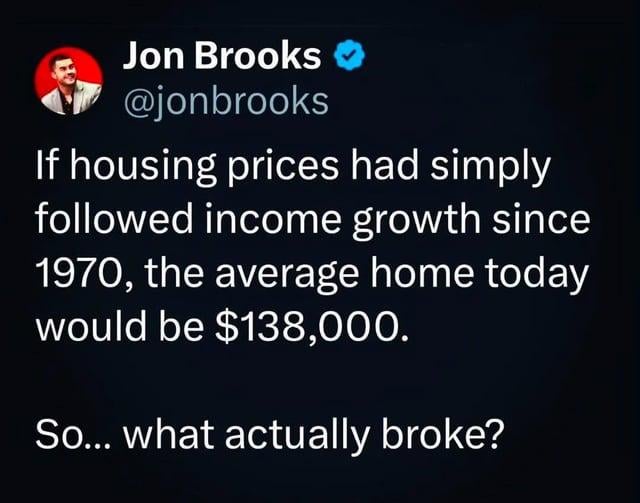
i think that lots of things broke.
the consequence is that new houses are bigger, and therefore more expensive.
there’s also other issues that are sometimes being quoted, such as: housing being seen as a commodity, housing being held by a few big house-owners. but i’m not convinced that that alone could cause prices to skyrocket.
if there’s a whole lot of developers trying to gain from housing economy, then there would be more houses being built until there’s more housing supply than demand, then prices would go down again until they stabilize somewhere. but that doesn’t seem to be what’s happening.
sometimes, the city and community are called responsible for keeping land area expensive (by not making more land area available to be built on). this probably varies geographically, and i find it quite hard to believe that communities around the (western) world would not have realized this one simple trick to make houses more affordable again. so i guess there’s more to it.
deleted by creator