

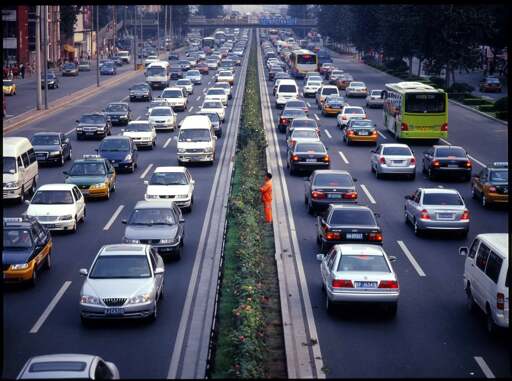
Though progress is often slow, city planners and politicians are gradually waking up to the fact that when cities offer safe and affordable alternatives to cars, we start to travel differently.
More and more young people are choosing bicycles, buses and trains over owning a car out of the sheer cost. In Berlin, it’s public transport, not cars, which is the coolest way of getting around.
In Copenhagen, a city that has a long held reremovedtion for being bike-friendly, a whopping 62% of people choose to cycle their commute.
In the French city of Lyon, the number of cars entering the city has fallen by 20% compared to just a decade ago. As the city’s network of bike hire stations continues to grow, town planners are hoping for a further 20% decline.
In London, where cycle super-highways are becoming popular, the share of journeys made by car has fallen by a quarter since 1990.
Car free days are rising in popularity in many of the world’s largest cities, giving people a taste of what it’s like to live with less noise, traffic and pollution. Bogota was one of the first cities to introduce a car free day, and it’s now become so popular that it’s been extended to a full week.
Bogotá’s Ciclovía is fantastic! I was there in the mid-nineties and they closed a major artery, the Carretera Séptima, on Sundays. Here some pictures.
There is not going to be a one size fits all solution for all countries and regions.
In cities you need public transport and walking/biking facilities. Car infrastructure is too expensive.
In suburbia, getting households to go from dual car to single car, you need public transport and bike facilities.
For rural, public transport is not really cost effective, so you are going to need to incentivise self power generation and home charging. Popularizing from high speed ebikes might be a good option though.
I’m on the edge of suburbia, butting up against ag rural. It’s ten miles to the next town either direction. My bike gets forty on a full charge. And most of the streets (with the exception of the major roads every couple miles, most of which have functional bike lanes) are one and a half lanes wide, 25 MPH and I usually only see people walking their dogs and the postmister when I’m out there. My 20mph governed ebike does great for getting me around locally. I ended up slapping a collapsible 35L milk crate on the back (I think that’s the right volume) for when I need to pick up a couple hundred pounds of kitty litter. Which the wife says is tomorrow yaaaay
I guess my point is (I actually have one this time!) I bet a bunch of rural folk could do pretty well using an ebike as their primary vehicle
They’re slowly adding bike lanes along some rural roads in Sweden. I wish they’d hurry it up, because with e-bikes and cargo bikes you could just skip having a car, especially if they added some good bike garages near bus/train stations.
Yeah, the only reason we have them on county/rural road here is two of the guys in the county board of supervisors (think city council but the whole damn county) are the cool lycra dudes. They insisted they put them in on specific roads to use as a bike route between towns/cities. I mean sure they benefited personally from that, but really don’t most people benefit from better bike infrastructure (not just them)?
I probably wouldn’t have gotten my trike if it weren’t for them trying to make it safer to ride, honestly. I worked with one of them specifically on homelessness projects and I just realized I haven’t shown him my trike yet. I gotta fix that.
I think so too, e-bikes are very underrated. it becomes a problem if the distances get to 30-50 miles between townsthough. Maybe some battery swap tech with solar recharging stations could do the trick.
Battery swap is here, since I can unplug and remove mine with the turn of a key. I just need more batteries
We really have to do something about tires though, their usage is one of if not the biggest sources of micro plastic pollution. Everybody is usually so focused on emissions and social/infrastructure aspects that they miss a lot of the other problems with cars.
I think much like with CFCs, this can be addressed by regulating tires to have longer life and not rely on the materials that generate micro plastics.
I also think cars should come with a 25 year warranty. To force manufacturers to make them to last. Japanese cars from the 90s are doing 30-35 year lifespans when maintained.
So, how do you think does the rest of world’s rural population outside of the US and Europe move?
deleted by creator
Actually, I am in Africa, so I am very aware of the situation. Outside of cities and Major towns, people are often trapped with little access to transport. They can only afford to travel to local towns, once or twice a month to access services like healthcare and professional services. For goods they usually have to coordinate as a community to get a goods truck to bring them items.
The problem with rural areas is that the tax base is too low to warrant the cost of infrastructure investment. Its cheaper for those people to move to larger towns and cities. In the “old world” they at least have the advantage of dense and walkable towns.
The US as the problem that their small towns are build car centric, and subsidized by taxes from urban tax payers. They will need reabilitate their towns to build over the top of roads and radically rework their power, electricity and sewage infrastructure.
They don’t move very much. They go as far as they can afford private transport to take them. Hopefully to a town where public transport to other towns are available.
I have been a good while in Colombia and there, rural people use microbuses and vans to get everywhere. I’d guess they have better public transport than Germany. Very few people can afford a car.
I think it is pretty much the same in the rest of South America.
We see the same in South Africa. Rural People here spend close to 60% of their income on those micro busses. That is not sustainable.