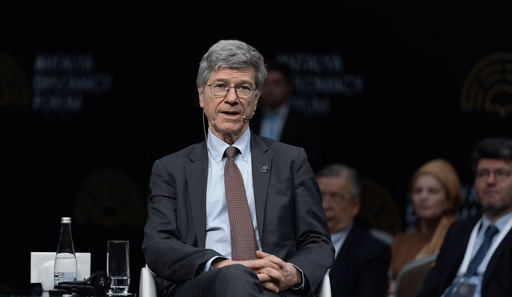
Economist and diplomat Jeffrey Sachs is calling on German Chancellor Merz to begin immediate talks with Russian President Vladimir Putin about peace in Europe. Jeffrey D. Sachs | May 27, 2026 | Berl
This is the problem with spending 4 years antagonizing your population about the “russian threat” - now you have to pay a political price for pursuing peace. This was obvious to everyone from the start, but most of those voices have been denounced to the fringes of the debate, with the good ol’ european neocons setting the agenda in the mainstream media (the same which happens in the US everytime they initiate a conflict).
Germany’s industrial economy was built on trade with Russia. The destruction of Nord Stream and the subsequent severance of Germany’s trade relations with Russia have left Germany buying natural gas from the United States at prices several times higher than the Russian pipeline gas it replaced. This is industrial suicide. Germany’s chemical sector, its steel sector, its glass industry, its energy-intensive manufacturers — the very foundations of the Mittelstand — are losing international competitiveness day by day. Skilled jobs are draining out of the German economy. And the German taxpayer and the German consumer are making a transfer of national wealth from Germany to American gas producers at a scale unprecedented in postwar Europe.
As for the German economy, generally they can’t out-capitalism the contradictions arising from capitalism itself - or there is one way to do it, which we saw 100 years ago as well:
On top of this, the German government is now pledging an enormous defence build-up — hundreds of billions of euros over the coming decade — to arm for a war that diplomacy can easily prevent.
In a sense this might be the “easy” thing for mr Chancellor to do (at least in the mind of a liberal), the constant fearmongering gives him political leeway to go all-in on state spending, try to revitalize the economy and have military spending drive industrial activity. The problem here is two-fold though:
Military spending doesn’t have as good of a return as, for instance, spending on infrastructure or integration of vertical (civil) logistic chains. So it has to be even more justified than such initiatives.
Following from 1), having a large standing military is wildly expensive in and out of itself. Now if you are are war this could be justified to the populace (for instance in the case of an invasion), but even less so if it is military endeavours outside of the nations borders (see the US). Either you have to have the population heavily propagandized (well they are not so far off in that aspect are they), or you have to come up with some other way of justifing the expenditure to the public.
@cfgaussian do you have any further points here? Maybe I am missing the German perspective here. Not that professor Sachs letter will turn the tables domestically, but the coming months will be important, how does it seem internally?
Nothing to add. I think Sachs is both correct in everything he says here and incredibly naive to believe anyone in the German leadership is going to listen. We are driving toward a cliff, the foot is still on the gas, and the passengers are asleep.

This is the problem with spending 4 years antagonizing your population about the “russian threat” - now you have to pay a political price for pursuing peace. This was obvious to everyone from the start, but most of those voices have been denounced to the fringes of the debate, with the good ol’ european neocons setting the agenda in the mainstream media (the same which happens in the US everytime they initiate a conflict).
As for the German economy, generally they can’t out-capitalism the contradictions arising from capitalism itself - or there is one way to do it, which we saw 100 years ago as well:
In a sense this might be the “easy” thing for mr Chancellor to do (at least in the mind of a liberal), the constant fearmongering gives him political leeway to go all-in on state spending, try to revitalize the economy and have military spending drive industrial activity. The problem here is two-fold though:
Military spending doesn’t have as good of a return as, for instance, spending on infrastructure or integration of vertical (civil) logistic chains. So it has to be even more justified than such initiatives.
Following from 1), having a large standing military is wildly expensive in and out of itself. Now if you are are war this could be justified to the populace (for instance in the case of an invasion), but even less so if it is military endeavours outside of the nations borders (see the US). Either you have to have the population heavily propagandized (well they are not so far off in that aspect are they), or you have to come up with some other way of justifing the expenditure to the public.
@cfgaussian do you have any further points here? Maybe I am missing the German perspective here. Not that professor Sachs letter will turn the tables domestically, but the coming months will be important, how does it seem internally?
Nothing to add. I think Sachs is both correct in everything he says here and incredibly naive to believe anyone in the German leadership is going to listen. We are driving toward a cliff, the foot is still on the gas, and the passengers are asleep.
Sad to hear, I am starting to fear for what this meant for Europe the coming years.
I see it as naive in the same way as Lady Macbeth and Pontius Pilate were, in the washing of the hands.