
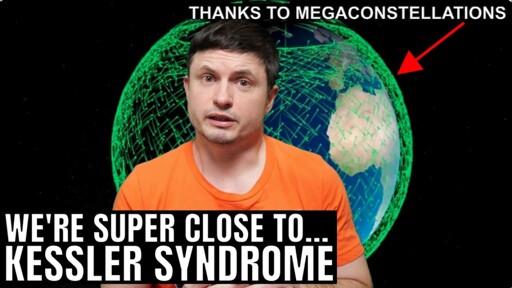
Video from Jan 1, 2026, that popped in my feed and I completely missed.
[YouTube AI summary] Anton Petrov examines a study highlighting how high-density satellite networks create a fragile ‘house of cards’ in low Earth orbit. The analysis focuses on the rapid increase in collision risks due to limited maneuvering time and the potential impact of extreme space weather.
Not sure about the altitude, but you’d probably want something that explodes into a bunch of shrapnel around other objects. I think the idea would be that the shrapnel starts to take its own orbit, smashing into its own things, destroying and creating even more shrapnel. Like a chain reaction.
Maybe a burst that maintains shrapnel in as high an orbit as possible that will decay slowly, maximizing the opportunity for collisions?
Yeah. It would need to be brittle so that it fragments, probably something that releases a lot of energy on impact. Maybe a quartz structure, if it could survive the temperatures?
If it explodes as an orb, you’ll lose most of your material to space or the atmosphere. Probably want a shrapnel cone in line with the orbit, maybe angled a little spaceward so more material gets into higher orbit to eventually decay.
I think I Barliman Butterburred it: Start off at as low a trajectory as possible, and shoot the cone upward so the bulk of it reaches high orbit and starts to decay. That’ll cross the most pathse. Bonus: Find out what the prevalent direction of sattelites is and try to go opposite to maximize delta v and passes-per-orbit.